
The Next Data Center Cooling Challenge Isn’t Just Heat.
It’s Water.
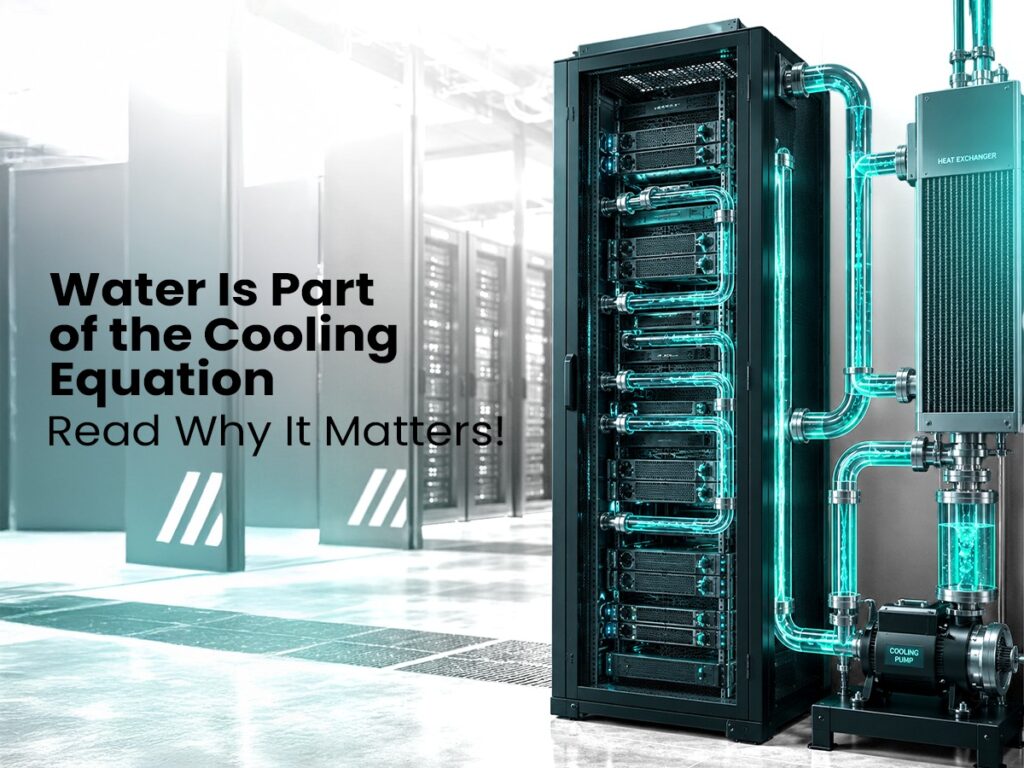
Data center cooling used to be a simple question: how do we remove heat and keep equipment running safely? Today, the question is broader. As facilities grow and computing becomes more demanding, operators also need to think about how much water and energy their cooling systems use.
This does not mean water-based cooling is a bad choice. In some locations, using water can lower the amount of energy needed for cooling. In other locations, water may be limited or expensive. The right answer depends on the site, the climate, the equipment, and the way the data center is designed.
Why Water Matters in Data Center Cooling
Servers create heat whenever they run. That heat has to move away from the equipment and eventually out of the building. Data centers can do this in several ways, including air cooling, chilled-water systems, evaporative cooling, and liquid cooling.
Some systems use water as part of the heat-removal process. For example, evaporative cooling towers lose some water as they remove heat. The U.S. Department of Energy notes that water use is linked to the amount of IT heat being produced and to the efficiency of the cooling system.
At the same time, water can sometimes help reduce energy use. Google has reported that water cooling can use less energy than air cooling in many locations. That is why water and energy should be considered together rather than treated as separate issues.
There Is No One Cooling Strategy for Every Data Center
A data center in a cool climate does not face the same conditions as one in a hot or water-stressed region. The best cooling choice for one facility may be the wrong choice for another.
Operators need to look at several factors at the same time: local climate, water availability, rack density, energy use, reliability needs, future growth, and the type of cooling system already in place.
This is why cooling is becoming a design decision, not just an equipment decision.
How Closed-Loop Cooling Changes the Picture
Closed-loop cooling systems reuse the same coolant repeatedly inside the system. That can reduce the need for a constant supply of new water.
Some modern data center designs use direct liquid cooling together with dry coolers. In the right conditions, this can remove heat from high-density equipment while keeping ongoing water use very low. ASHRAE has described closed-loop dry-cooler designs that can operate with little ongoing water use, although some hybrid systems may still use limited water during hot weather.
The key point is simple: liquid cooling does not automatically mean high water consumption. What matters is how the full cooling system is designed and how it rejects heat outside the facility.
Higher Computing Density Is Raising the Pressure
New generations of high-performance computing equipment can produce more heat in a smaller space. That makes cooling harder and can push traditional air-cooling systems closer to their limits.
As rack density rises, data center teams need to think about cooling earlier in the design process. The question is no longer only how to remove more heat. It is how to remove that heat while also managing water, energy, capacity, and reliability.
Measuring Water Use More Clearly
One useful measure is Water Usage Effectiveness, or WUE. It compares the amount of water used at the site with the energy used by IT equipment. Tracking WUE can help operators understand how water-efficient a data center is over time.
But one number never tells the whole story. A system that uses very little water may need more electricity, while a system that uses some water may lower total energy use. Good decisions come from looking at the full picture.
Cooling Is Also Becoming a Location Decision
Water availability is now part of where and how data centers are built. Major operators increasingly consider local water conditions when choosing cooling methods and may use options such as air cooling, recycled water, or other low-water approaches where water risk is higher.
This means a cooling strategy should be planned together with site selection, energy supply, expected workloads, and future expansion.
The Goal Is Balance
There is no single cooling technology that will be right for every data center. Some facilities may benefit from air cooling, others from liquid cooling, closed-loop systems, evaporative cooling, or a mix of approaches.
The bigger shift is in how the decision is made. Data center cooling now needs to balance temperature, water use, energy efficiency, performance, future capacity, and operational resilience.
The question is no longer just, ‘How do we keep the data center cool?’ It is, ‘What is the best way to manage heat, water, and energy together?’
Building Smarter Thermal Infrastructure
As data center requirements change, thermal management is becoming a strategic infrastructure decision rather than a simple cooling task.
IoT Misr provides Thermal Management and integrated data center solutions that help organizations build efficient, reliable, and resilient critical environments.
By looking at cooling as part of the wider data center infrastructure, organizations can make better decisions around performance, capacity, efficiency, and long-term operations.
Contact IoT Misr about building a thermal management strategy designed around the needs of your data center.