
GPON Technology as a Backbone for Modern Network Infrastructure
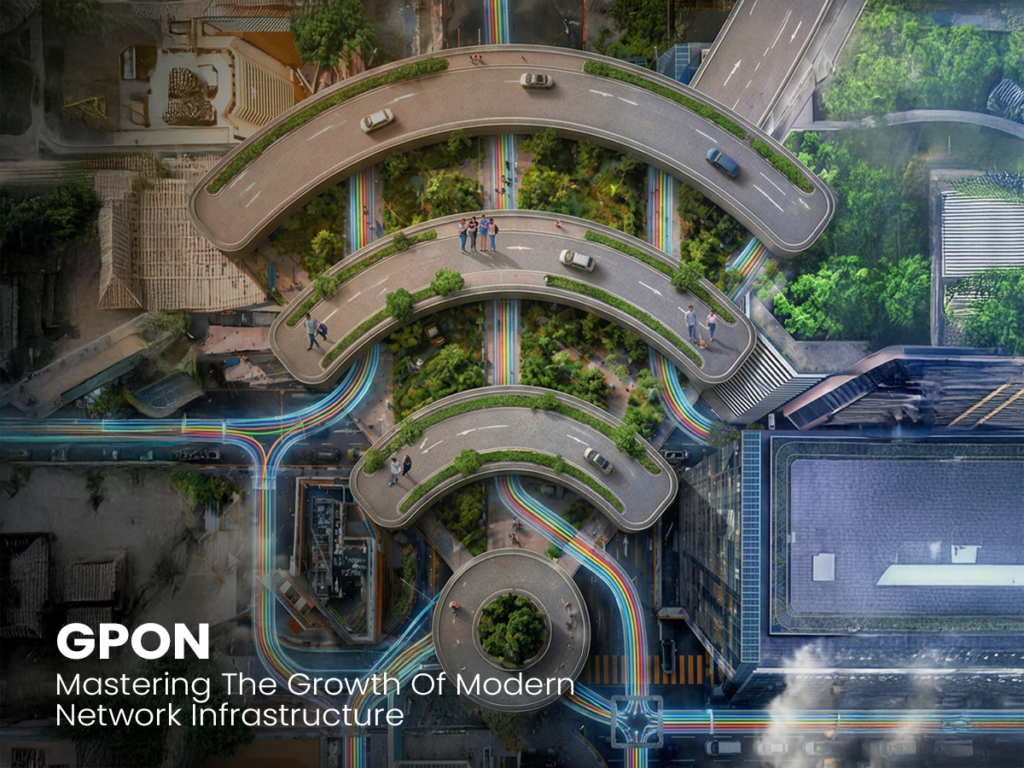
As global demand for high-speed, reliable connectivity continues to accelerate; traditional access networks are increasingly unable to meet modern performance requirements. The shift toward fiber-based infrastructure has become essential to support bandwidth-intensive applications, cloud services, and the growing ecosystem of connected devices. Among the leading solutions, the Gigabit Passive Optical Network (GPON) stands out as a robust and scalable technology. This paper argues that GPON is not only an efficient access solution but also a critical enabler of digital transformation across industries.
Understanding GPON Technology
GPON is a fiber-optic access technology based on a point-to-multipoint architecture. It enables a single optical fiber to serve multiple endpoints using passive optical splitters, eliminating the need for active components in the distribution network. This architecture significantly reduces energy consumption and operational complexity while maintaining high performance.
At the core of GPON is the Optical Line Terminal (OLT), located at the service provider’s central office, which connects to multiple Optical Network Units (ONUs) or Optical Network Terminals (ONTs) at the user side. Data transmission occurs over optical wavelengths, allowing simultaneous upstream and downstream communication with minimal signal degradation.
Unlike legacy copper-based systems, GPON provides a unified platform capable of delivering data, voice, and video services over the same infrastructure, making it highly efficient for both residential and enterprise environments.
Key Characteristics of GPON
High Bandwidth Capacity: One of the defining features of GPON is its ability to deliver gigabit-level speeds. It supports high downstream and upstream data rates, making it suitable for modern digital services such as high-definition streaming, cloud computing, and real-time data processing.
Efficient Resource Utilization: Through the use of passive splitters, GPON allows multiple users to share a single fiber connection. This significantly reduces infrastructure costs while maintaining service quality. Dynamic Bandwidth Allocation (DBA) further enhances efficiency by distributing bandwidth based on real-time demand.
Extended Reach: GPON networks can operate effectively over long distances, typically up to 20 kilometers, without requiring signal regeneration. This makes it ideal for wide-area deployments, including urban and industrial environments.
Reliability and Low Maintenance: The absence of active components in the access network reduces points of failure and minimizes maintenance requirements. This leads to improved network stability and lower operational costs.
What Distinguishes GPON from Other Technologies
What sets GPON apart is its balance between performance, scalability, and cost efficiency. Unlike traditional Ethernet-based access networks, which require extensive active switching infrastructure, GPON leverages passive components to simplify network design.
Additionally, GPON is inherently scalable. Network operators can increase capacity and extend coverage without major infrastructure changes. This adaptability makes it a future-proof solution capable of supporting evolving technological demands, including IoT integration, smart city applications, and industrial automation.
Furthermore, GPON offers strong Quality of Service (QoS) capabilities, ensuring that critical applications receive prioritized bandwidth. This is particularly important in environments where reliability and performance are essential.
The Impact of GPON on Modern Networks
The adoption of GPON has had a transformative impact on communication infrastructure. Its high-speed capabilities enable seamless access to digital services, supporting both consumer and enterprise needs.
In industrial contexts, GPON plays a vital role in enabling smart operations. It provides the backbone for IoT deployments, allowing sensors, devices, and systems to communicate efficiently. This connectivity supports real-time monitoring, predictive maintenance, and data-driven decision-making.
From an economic perspective, GPON reduces both capital and operational expenditures. By minimizing the need for active equipment and optimizing resource utilization, organizations can achieve significant cost savings while improving service quality.
Moreover, GPON contributes to the development of future-ready infrastructure. As data demands continue to grow, its scalability ensures that networks can evolve without requiring complete redesigns, making it a sustainable long-term investment.
GPON Implementation at IoT Misr
At IoT Misr, the adoption of GPON technology represents a strategic step toward building high-performance, scalable network infrastructure. By implementing GPON, we have enhanced our ability to deliver reliable connectivity solutions that meet the demands of modern digital environments.
This deployment has enabled improved operational efficiency, seamless integration of connected systems, and stronger support for IoT-driven applications. More importantly, it positions IoT Misr at the forefront of technological advancement, reinforcing our commitment to enabling smart, future-ready solutions.
In an era where connectivity defines progress, GPON is not merely a network upgrade, but a foundational technology that drives innovation and transformation.
Reach out to us to explore how GPON can transform your network.